'The heat has come'
Woolf on This Day, 1926

If you are reading this in an early summer heatwave, then you’ll find it slightly easier to transport yourself back to May 1926. As Virginia writes in her diary ‘The heat has come.’ With it come memories of the social ‘season’ that ran in London throughout the summer, and although it’s been a long time since she was dragged out to a party by her half-brother George Duckworth, the memory of those oppressive evenings still haunts her.
Fortunately there are distractions: Vita had returned from Persia on May 16. She had recently finished The Land, a long nature poem in the style of Virgil’s Georgics that would go on to be her most celebrated work. In the meantime, Virginia had been working on her own masterpiece – To the Lighthouse. She had just completed the sublimely poetic section now known as ‘Time Passes,’ where years of spring and summertime growing cause nature to run wild in an abandoned garden.
Tuesday 25th May 1926
The heat has come, bringing with it the inexplicably disagreeable memories of parties, & George Duckworth; fear haunts me even now, as I drive past Park Lane on top of a bus, & think of Lady Arthur Russell & so on. I become out of love with everything; but fall into love as the bus reaches Holborn. A curious transition that, from tyranny to freedom. […]
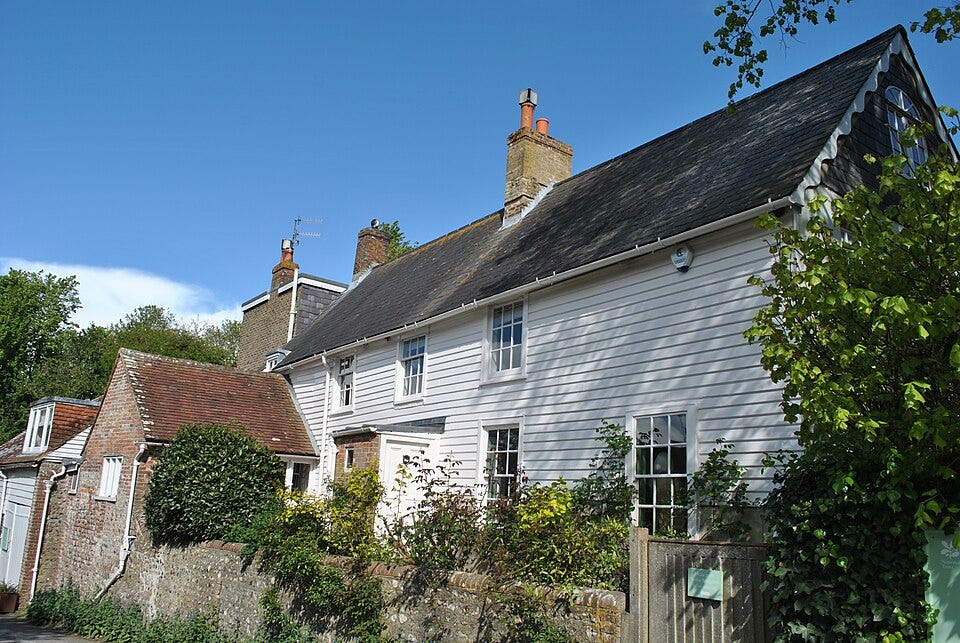
Now we have been sitting in the Square. L. is better. I am happier. Tomorrow we go to Rodmell – to find the bath & the W.C. & the drawing room with the wall pulled down. This cherry has been dangled & withdrawn so often that I scarcely believe we shall now munch it. And I must note that the Strike still makes it necessary for me to find out trains at Victoria.
I have finished – sketchily I admit - the 2nd part of To the Lighthouse – & may, then, have it all written over by the end of July. A record – 7 months, if it so turns out.
Vita came: & I register the shock of meeting after absence; how shy one is; how disillusioned by the actual body; how sensitive to new shades of tone – something ‘womanly’ I detected, more mature; & she was shabbier, come straight off in her travelling clothes; & not so beautiful, as sometimes perhaps; & so we sat talking on the sofa by the window, she rather silent, I chattering, partly to divert her attention from me; & to prevent her thinking “Well, is this all?” as she was bound to think, having declared herself so openly in writing. So that we each registered some disillusionment; & perhaps also acquired some grains of additional solidity – This may well be more lasting than the first rhapsody. But I compared her state, justly, to a flock of birds flying hither thither, escaped, confused: returning, after a long journey, to the middle of things again. She was quieter, shyer, awkwarder than usual even. She has no ready talk – confronted by Nelly or Mrs Cartwright she stands like a schoolgirl. […]
When Vita and Virginia began their affair in December 1925, it was a tentative, cautious attachment. Vita was worried about jeopardising Virginia’s health, and Virginia was concerned (as she often was) about the possibility of rejection. The thrill of finally acknowledging their feelings was intensified by Vita leaving for Tehran at the start of the year, a situation that gave them a handful of hurried opportunities to play the parts of lovers before being briskly pulled apart.
Virginia’s report of their reunion reveals how fresh their connection was. Long distance letters made them free and affectionate, but after this outpouring of romance, the physical reality of being in the same room was a little disappointing. Perhaps, Virginia thinks, they both ‘acquired some grains of additional solidity’, as though they hadn’t been real to one another until now.
‘She has no ready talk […] she stands like a schoolgirl,’ Virginia writes accusingly. Not for the first time, she seems taken aback by the object of her desires, as though Vita’s very vulnerability was an affront. Behind all this pouting is an anxiety concerning her own vulnerability. “Well, is this all?” she imagines Vita thinking on seeing her again. For two women who were so adept at weaving fictions and fantasies, this moment constitutes a rare and bracing moment of clarity. But it won’t be long before the veil falls again, and Virginia goes back to inventing the person she wanted Vita to be, a pearl-hung, immortal heroine. It was this person who would turn out to be the subject of her next novel, Orlando.
Absolutely, the possibilities for projection must have been huge!
So lovely.
We all experienced that moment of falling down back to earth after idealising someone... How stronger must the fall have been back then, when you had no instant communication but only letters that left plenty of space for fantasy (and love) to run free!