Woolf on Strike
Marking 100 years since the General Strike of 1926

On a morning in May one century ago, three million workers went on strike. In an unprecedented act of defiance, they managed to grind the country to a halt. Trains and buses stopped; factories closed their doors.
Most workers were striking in solidarity with coal miners who were under the thumb of a punitive Conservative government. The prime minister, Stanley Baldwin, (the same Prime Minister who goes to Mrs Dalloway’s party in Woolf’s novel) was heavily invested in coal mining through his family firm Baldwins Ltd. He and a group of other mine owners responded to a worldwide slump in the price of coal by imposing lower wages and longer hours on their workers. They fought tirelessly against a minimum wage and sought to impose a 12-day working fortnight. The British Trade Union Congress (TUC) responded with force, encouraging all workers to down tools.
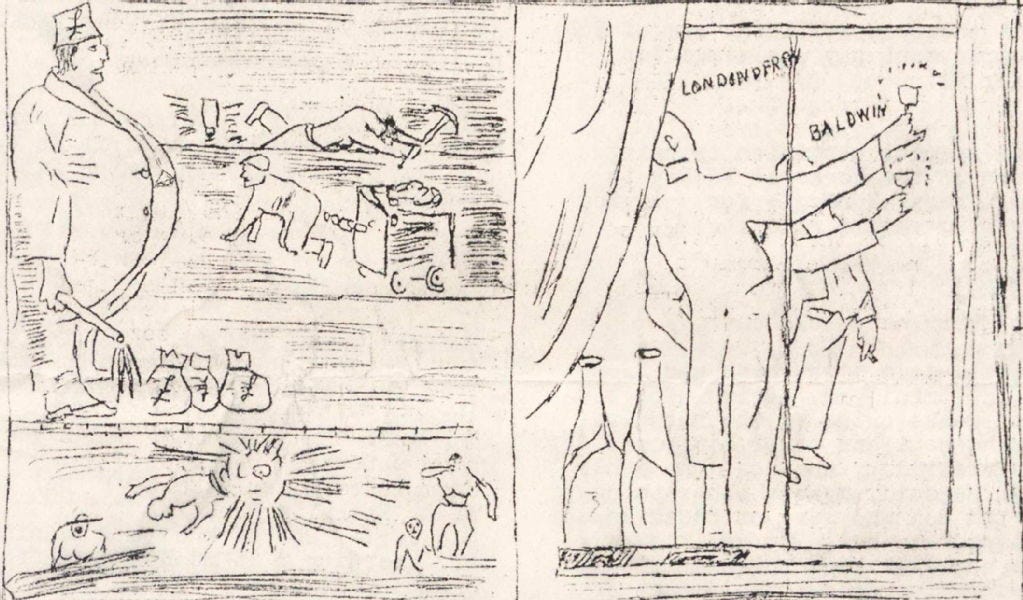
The reaction of the British public was, according to the London Illustrated News, rather sanguine:
‘The peculiarly British characteristic was very evident during the General Strike, which began at the bidding of the Trade Unionists, on Tuesday May 4th. After the King declared “a State of Emergency” the nation rose splendidly to the occasion, and faced the situation with calmness, courage, and above all, good humour.”1
Much as the newspapers reported on the British tendency to ‘carry on,’ the irony was that many of them would have to cease production in the days that followed. Without a daily paper to update them on negotiations, British citizens clung to radio broadcasts from the BBC, one of the few organisations that was working overtime instead of reducing its output. The traditional ban on news before 7pm was lifted so that listeners could benefit from five bulletins a day.2
As political as well as cultural commentators, Virginia and Leonard Woolf were positioned at the very heart of this debate. Leonard, who was on the side of the miners and strikers, referred to it as ‘the most painful and horrible event.’ He helped enlist the support of artists and writers in an appeal to the government to negotiate with the TUC and sent messengers around London on bicycles collecting signatures. According to his biographer, Victoria Glendinning, ‘the telephone rang non-stop at 52 Tavistock Square.’3 As those of you who’ve been reading ‘Woolf in the World’ will know, he fought brutishly with one of the Hogarth Press managers, Mrs Cartwright, because she supported the Conservative side.
I’ll let Virginia’s diary take us through what followed, starting from May 6th, just as the reality of the situation was beginning to set in.
Thursday May 6th
(one of the curious effects of the Strike is that it is difficult to remember the day of the week.) Everything is the same, but unreasonably, or because of the weather, or habit, we are more cheerful, take less notice, & occasionally think of other things. The taxies are out today. There are various skeleton papers being sold. One believes nothing. Clive dines in Mayfair, & everyone is pro-men'; I go to Harrison [Woolf’s dentist], & he shouts me down with “Its red rag versus Union Jack, Mrs Woolf […]
The shops are open but empty. Over it all is some odd pale unnatural atmosphere – great activity but no normal life. I think we shall become more independent & stoical as the days go on.
Friday May 7th
No change. “London calling the British Isles. Good morning everyone.” That is how it begins at 10. The only news that the archbishops are conferring, & ask our prayers that they might be guided right. Whether these means action, we know not. We know nothing. Mrs Cartwright [Hogarth Press manager] walked from Hampstead. She & L. got heated arguing, she being anti-labour; because she does not see why they should be supported and, & observes men in the street loafing instead of working.
Sunday 9th May
There is no news of the strike. The broadcaster has just said that we are praying today. And L. & I quarrelled last night. I dislike the tub thumper in him; he the irrational Xtian in me.
Monday 10th May
Quarrel with L. settled in studio. Oh, but how incessant the arguments & interruptions are! As I write, L. is telephoning to Hubert. We are getting up a petition. […] Meeting mysteriously called off today. Otherwise strike wd. have been settled. I to H of Commons this morning with L.’s article to serve as stuffing for Hugh Dalton the Commons this afternoon.
The petition called for the government to ‘restart negotiations immediately on the lines suggested by the Archbishop of Canterbury.’
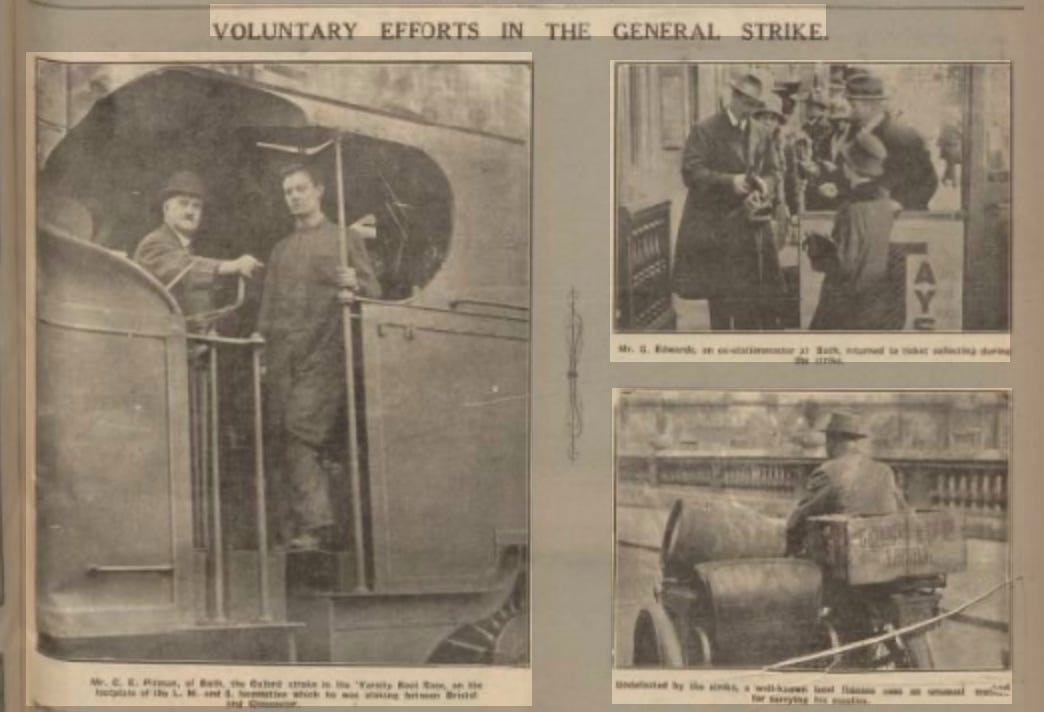
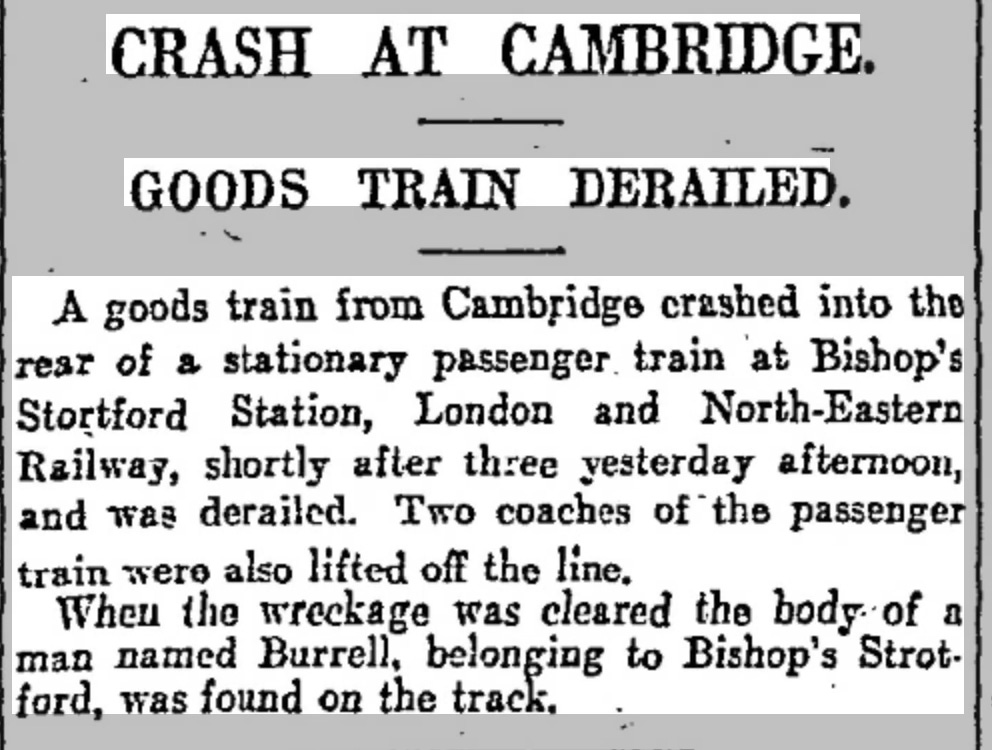
In the meantime, hoards of undergraduates were recruited to stand in for the striking workers, some of whom were trusted to operate trains. The largest image above shows a varsity rower from Oxford on the footplate of the L. M. and S. locomotive which he was entrusted to help run between Bristol and Gloucester. The result of this tactic overall (rather predictably) were train crashes. In one case, two undergraduates operating the Flying Scotsman blew the cylinder heads of the train’s engine by starting it without opening the drain cocks, resulting in the deaths of three passengers. Woolf’s friends, Ralph and Frances Marshall, found themselves in a similar situation:
Thursday 11th May
Yesterday Ralph & Frances Marshall were in a railway accident. She had her teeth jangled. One man was killed; another had his leg broken – the result of driving a train without signals, by the efforts of ardent optimistic undergraduates. […] Mrs C[artwright] arrives on Faith’s bicycle which is red with rust.
Wednesday 12th May
Strike settled. (ring at bell)
The Strike was settled about 1:15 – or it was then broadcast. I was in Tottenham Court Rd. at 1 & heard Bartholomew & Fletcher’s megaphone declaim that the T.U.C. leaders were at Downing Street; came home to find that neither L or Nelly had heard this: 5 minutes later, the wireless. They told us to stand by & await important news. Then a piano played a tune. Then a solemn broadcast assuming incredible pomp & gloom & speaking one word to the minute read out: Message from 10 Downing Street. The T.U.C. leaders have agreed that Strike shall be withdrawn.
On the 13 May 1926: 'The British Gazette' reported that there had been an "unconditional surrender" by the strikers. When some strikers attempted to return to work, they were told they must reapply for their jobs and agree to worse employment conditions than before. As a result of this, workers resumed the strike with redoubled force – more went on strike than on any previous day.
By the 14th of May there was some weakening of the strikers as the railway unions agreed to conditions imposed by the railway companies. One of the terms they had to agree to included the statement “that in calling a strike they committed a wrongful act”. Negotiations with the coal miners continued as Baldwin arranged for the import of foreign coal. The miners wouldn’t return to work until the 27th of November 1926, and when they did so it was in a state of total defeat. They agreed to work for lower pay and longer hours.
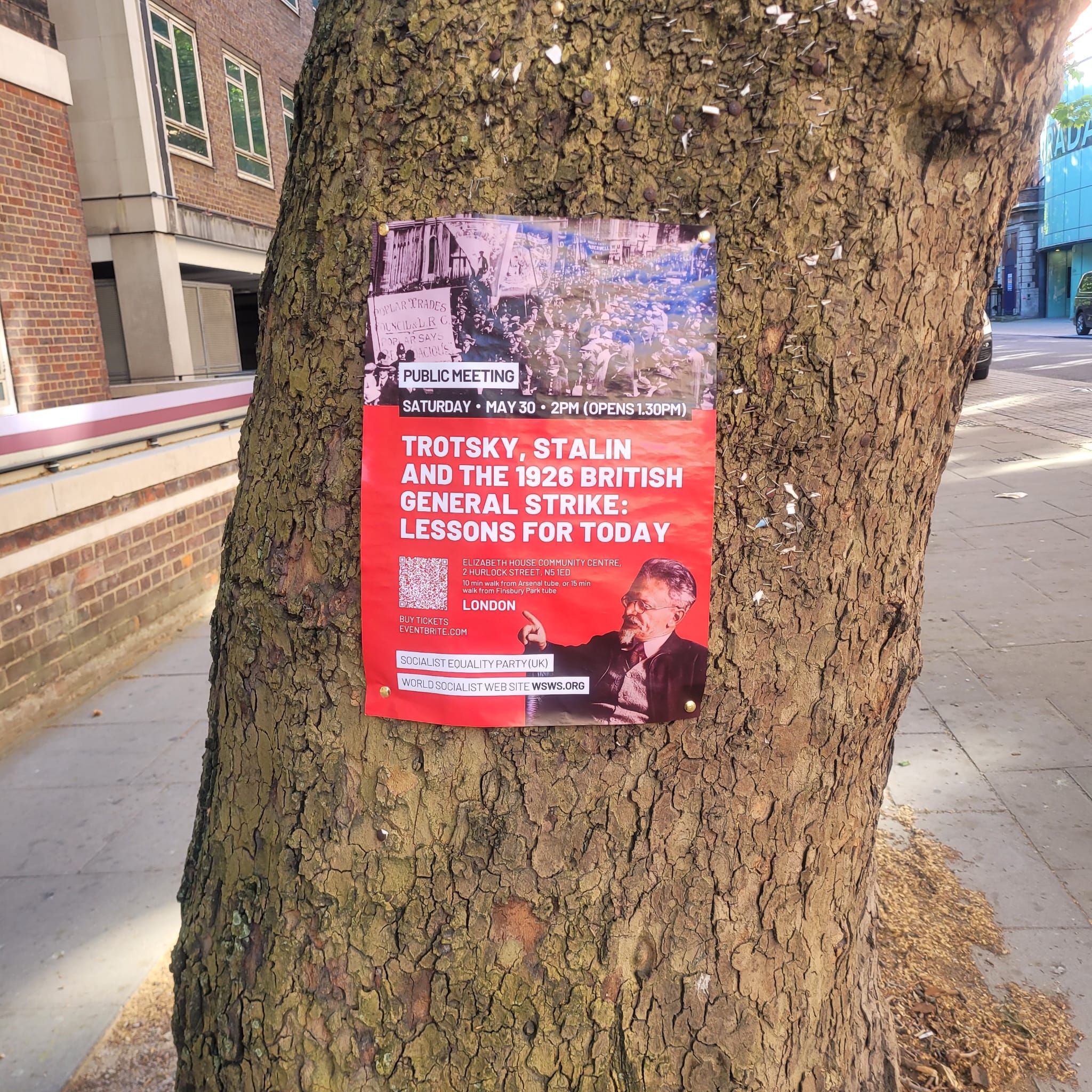
You can learn more about the Strike by visiting this excellent resource from the University of Warwick: https://warwick.ac.uk/services/library/mrc/collections/digital/gs/
‘The Spirit of England – ‘Carry on’”Illustrated London News - Saturday 22 May 1926
The ban on news before 7pm was implemented in 1922 to allow the newspapers to benefit economically: http://news.bbc.co.uk/aboutbbcnews/spl/hi/history/noflash/html/1920s.stm#:~:text=The%20escalation%20into%20a%20general,%22in%20every%20possible%20way%22.
Leonard Woolf, A Biography, (Free Press, 2006) p.243
Very interesting. Knowing this is the PM who attended Mrs. D’s party, I wonder what it was he and Lady Bruton were hidden in a room talking about.
Oh, dearie me, how tiresome this is for poor dear Ginny. She and Leonard epitomise the ‘champagne socialists' of their day.